What Is a Payment Gateway in Ecommerce? How It Works and Why It Matters

A payment gateway is a technology that securely collects and transmits customers’ payment information to banks that process online payments. After a consumer clicks the “Purchase” button on an e-commerce store, it completes information encryption, initiates transaction authorization, and returns an approval or rejection result within seconds. It acts as the core link connecting the e-commerce checkout experience to the financial system. This guide elaborates in detail on its definition, operational logic, and business value, as it is a core technology that all online stores must master to achieve efficient operation.

Samuel  D’Souza
Samuel D’Souza·Marketing Lead
Updated: July 10, 2026
9 minutes to read
payment gateway in ecommerce

What is an ecommerce payment gateway?

An e-commerce payment gateway is a digital service that collects and secures customers’ payment information during online transactions. Positioned between a merchant’s website and its payment processor, the gateway first captures payment data, encrypts it, and sends it to the payment processor, which then connects with the issuing bank and acquiring bank to complete the full transaction process. The payment gateway is only responsible for the secure transmission of data; it never holds funds or processes settlements, so it must not be confused with merchant accounts or payment processors. Clarifying this distinction helps e-commerce store owners accurately evaluate the value of a payment gateway. A ecommerce payment gateway like A-Pay combines simplicity with robust security. Payment gateways can support transaction processing for stores of all sizes, but different service providers have differing processing capacities, so merchants must select a gateway that matches their own transaction volume.
How does a payment gateway work in an ecommerce transaction?

A payment gateway follows a clear, step-by-step operating process, and the following text elaborates on the typical process by which an online store uses it to complete secure payments.

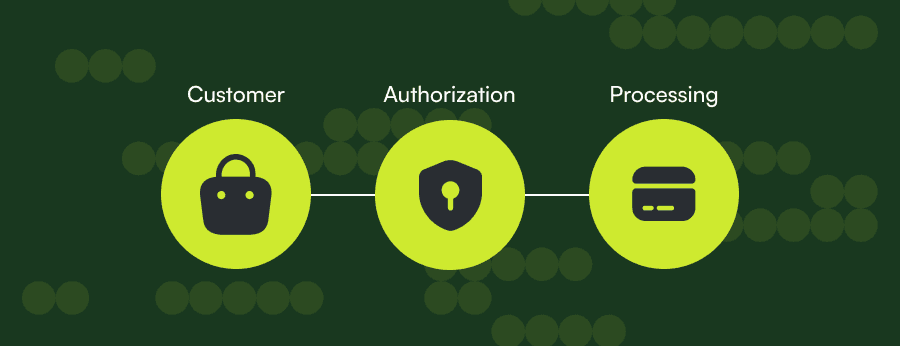
  1. Consumers submit the required payment information, including card number, expiration date, CVV, and other relevant details, on the online checkout page.
  2. The payment gateway adopts TLS/SSL technology to encrypt the transmission of payment data, which can safeguard the transmission security of payment details.
  3. The gateway then routes the information to the payment processor (or directly to the acquiring bank). 
  4. Every payment request is first routed through a payment processor, then transmitted to card networks such as Visa and Mastercard, and finally delivered to the issuing bank—that is, the consumer’s account-holding bank. All information sent to the corresponding payment processor is secured with end-to-end encryption.
  5. The issuing bank checks funds and risk, then sends an approval or decline back through the same chain. Response to the payment processor carries the auth code.
  6. After receiving the payment response, the payment gateway notifies the e-commerce platform to display the payment result to consumers, synchronizes its own transaction details, and updates users' order statuses.
  7. If approved, the merchant ships the goods; the actual settlement (movement of money) happens later. Payment processor via the payment gateway completes the cycle.

When a user selects a $50 backpack on an e-commerce website and clicks to submit payment, the entire process— from the payment gateway forwarding the transaction, interfacing with the payment processor, to securing bank approval—takes only a few seconds, leading the user to perceive the payment as instantaneous. However, back-end settlement still requires 1 to 2 days to complete. For faster funding, consider an instant settlement payment gateway. Payment gateways automate many aspects of transaction handling, saving you time.

Why payment gateways matter for ecommerce businesses

Many people mistakenly believe that payment gateways are merely unimportant technical details, but in fact, they affect three core business metrics: sales revenue, user trust, and operational costs. The following text will elaborate in detail on their core benefits for e-commerce.

  • Higher conversion – A smooth, fast checkout experience reduces cart abandonment. Customers leave if the payment page is slow or insecure.
  • Fraud prevention – Modern gateways include rules, velocity checks, and address verification to block suspicious transactions.
  • E-commerce platforms must display mainstream payment options familiar to users, as well as safety and compliance marks; implementing the 3D Secure function can effectively boost consumer confidence.
  • Online transaction platforms are required to establish a diversified payment support system, and all leading payment gateways have achieved full coverage of various payment methods adapted to the needs of all regions.
  • This global payment gateway supports multi-currency cross-border payment collection and is compatible with local payment methods across different regions; its relevant functions may only be enabled in regions that it explicitly covers.
  • Operational efficiency – Automates reconciliation, subscription billing, and refunds, saving staff hours.

High-quality e-commerce payment gateways meet PCI DSS compliance requirements, which can reduce the burden of security audits, lower the risks of data breaches and chargebacks, and ensure smooth transaction processing. To protect your store, choose a secure payment gateway. E-commerce payment strategies must incorporate fraud prevention and control tools.

payment gateway in ecommerce

What types of payment gateways are used in ecommerce?

There are several types of payment gateway in ecommerce, each with different tradeoffs between control, ease of integration, and compliance responsibility.

  • A hosted payment gateway redirects consumers to a secure page to submit their payment details, and returns them to the merchant’s page once the payment process is completed.
  • Integrated (non-hosted) payment gateway – Consumers can stay on the merchant platform to input cards and transmit data through API. Merchants have strong control and smooth UX, but they need to bear PCI compliance responsibilities and need to adapt to their own business selection.
  • A self-built payment gateway enables merchants to collect payment data on their own servers, maintain full operational control, and eliminate the need for page redirects. However, such gateways must be equipped with high-level security capabilities and pass PCI SAQ D compliance verification.
  • API-led / custom setups – Developers build a custom checkout flow using the gateway’s API. Offers maximum flexibility for complex ecommerce models (marketplaces, subscriptions). Tailor the payment flow to your exact requirements.

In popular science content focused on payment selection for e-commerce merchants, the three payment models — hosted payment, integrated payment, and self-hosted payment — each have unique suitability thresholds. For full brand control, explore a white label payment gateway. Merchants may select a model based on their technical resources and risk preferences, and the bank that processes payments is determined through gateway routing.

Payment gateway vs payment processor vs merchant account

Many people use these terms interchangeably, but they refer to different layers of the payment process.

Payment gateway

The software that captures and encrypts payment details and sends them for authorization. It does not move money.

Payment processors

are responsible for routing transactions to card networks and banks, and handling communications between acquiring banks and issuing banks; payment gateways are critical for merchants that need to manage multiple groups of acquiring partnerships.

Merchant account

A type of bank account that temporarily holds funds from card payments before they are settled into the business’s regular bank account. Selecting the right ecommerce payment structure affects your cash flow.

payment gateway in ecommerce

Example: When a customer completes a $100 e-commerce payment, within the native payment chain, the payment gateway transmits transaction data, the processor connects with Visa, and funds are temporarily deposited in the merchant account for 1 day before being transferred to the corporate account. Most small and medium-sized e-commerce operators choose Stripe and A-Pay, which bundle the three types of services. Clarifying the roles of each relevant entity enables comparison of handling fees and troubleshooting of settlement delays, and the gateway serves as the core safeguard.

How to choose the right payment gateway for your ecommerce business

Compliance & security

Look for PCI DSS Level 1, tokenization, 3D Secure, and fraud tools. Payment security can mitigate data breaches.

Transaction fees

When merchants connect to payment gateways, they must evaluate four categories of fees including per-transaction costs and monthly service fees. Merchants with high transaction volumes are eligible for preferential rate discounts, and payment gateways must meet PCI DSS compliance requirements.

Platform compatibility

Does the gateway should integrate with your ecommerce platform (Shopify, WooCommerce, Magento, custom)? Plugins reduce development time.

Payment methods

Does it support credit cards, digital wallets, bank transfers, and local payment methods (iDEAL, Klarna, UPI)? A payment gateway supports multiple payment types. Preferred payment method support increases conversion.

Currency & cross-border

Can it accept multiple currencies and settle in your local currency? Good for global payment expansion. Meet your global payment gateway needs by checking currency coverage.

Reporting & reconciliation

Does it offer clear dashboard, real‑time reporting, and automated reconciliation? Payment gateways automate many aspects of financial tracking.

Support & uptime

24/7 support and high uptime (99.95%+) are critical for ecommerce.

Scalability 

Will the gateway handle peak sales (Black Friday) without extra fees or performance drops? Sure your ecommerce payment gateway can scale with your growth.

Selecting the right ecommerce payment provider means balancing cost, features, and ease of integration. For merchants expanding across borders, an international payment gateway is often the best fit. Right payment gateway should match your business model.

What to know about ecommerce payment gateway integration and security

Integration methods

Use a pre‑built plugin for your platform, a hosted page, or a custom API integration. API-led setup gives full control but requires developer resources. Gateway should integrate seamlessly with your stack.

Sandbox testing

Always test in a sandbox environment before going live. Most payment gateways provide a test suite with dummy card numbers.

PCI DSS 

If you use an integrated/self-hosted gateway, you must comply with PCI DSS requirements. Hosted gateways reduce your PCI scope.

Tokenization technology

stores tokens rather than raw payment information. It can reduce security risks, simplify recurring billing, and requires all relevant data processed by this technology to be transmitted via dedicated channels.

Encryption

Ensure the gateway uses TLS 1.2+ for data in transit and encrypts data at rest. Payment gateway is a digital shield against data theft.

When a standard payment gateway is not enough anymore

A basic payment gateway only supports e-commerce businesses that operate within one country and use a single currency, and growth-oriented enterprises will quickly reach the upper limit of its service capabilities.

  • Entering new markets – You need local payment methods (e.g., iDEAL in Netherlands, Bancontact in Belgium). A standard gateway may not offer them.
  • Cross‑border sales – High fees and low approval rates for international cards. You need routing and multiple acquirers to boost approval rates. Payment solutions scale with multi‑acquirer setups.
  • Subscription / marketplace models – Basic payment gateways have functional limitations, and must adapt to meet the technical requirements of alternative payments
  • Faster settlement – Standard settlement takes 2‑3 days. Instant settlement payment gateway offers next‑day or same‑day funding.
  • White‑label / custom checkout – To control the full brand experience, you may need a white label payment gateway with API‑first infrastructure.

When an enterprise’s payment infrastructure becomes a development bottleneck, it can select multiple acquirer platforms, payment process orchestration tools, or A-Pay, which supports global payment routing. A lack of local payment method support will force enterprises to stack multiple payment gateways.

Frequently Asked Questions