What Is KYC?
KYC (Know Your Customer) is a widely used compliance management mechanism in the financial sector, applicable to all types of merchants and fintech companies. To implement KYC, relevant entities must first collect customers’ name, address, date of birth, and official ID number, verify these details against trusted sources, then carry out ongoing due diligence, risk assessment, and regular customer reviews.
The entire process must leave traceable, auditable records; enhanced due diligence must be implemented for customers requiring additional review. Properly executed KYC can reduce fraud risks, meet regulatory requirements, and build a secure industry ecosystem.
In contrast, the absence of KYC leaves entities unable to identify their service users, and increases the likelihood of suffering from financial crimes.
What Is AML?
AML or anti-money laundering refers to the entire system of laws, monitoring, and reporting designed to detect and prevent financial crime. Anti-Money Laundering (AML) is not limited to completing only initial identity verification; rather, it is a set of legal, regulatory and internal control frameworks covering the full lifecycle of money laundering, that encompasses core operational requirements including transaction monitoring and suspicious activity reporting.
Global AML standards are formulated by the Financial Action Task Force (FATF), which countries transpose into their local legislation. For financial institutions to build an effective AML program, they must equip themselves with supporting systems, staff training, independent audits and customer due diligence modules, while also accounting for counter-terrorism financing prevention, and adhering to the risk-appropriate principle.
Most jurisdictions mandate mandatory watchlist screening, and the absence of a comprehensive AML solution will leave enterprises exposed to money laundering risks.
AML vs KYC: What’s the Difference?
Understanding the key differences between AML and KYC helps compliance teams allocate resources correctly. Anti-Money Laundering (AML) and Know Your Customer (KYC) in the financial compliance field are often confused. Their core differences can be clarified across four dimensions: scope, timing, purpose, and frequency.
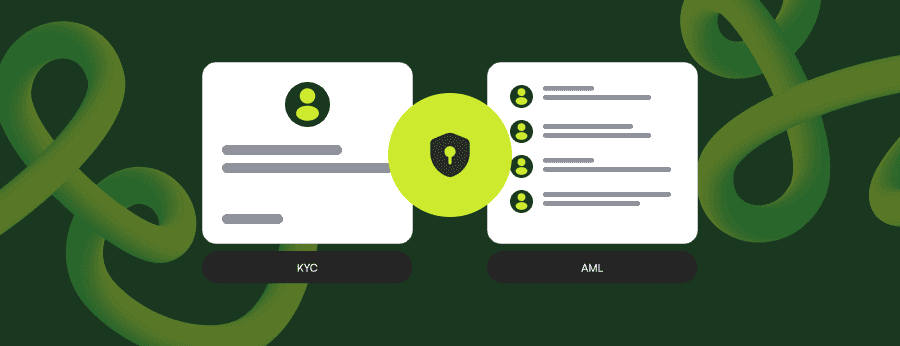
KYC is an identity information collection and verification step carried out only during the customer onboarding stage and at regular intervals afterwards, serving as a key subset and core tool of AML. In other words, KYC is a subset of the broader AML framework.
AML, by contrast, is an overarching compliance framework that covers KYC, ongoing transaction monitoring, enhanced due diligence, and suspicious activity reporting, with its monitoring work operating on a continuous basis.
Accurately distinguishing between the two can help B2B entities allocate compliance resources reasonably. Failure in any part of either process will lead to regulatory fines and reputational damage, so enterprises must build both a sound upfront KYC system and a continuous AML monitoring mechanism. For businesses handling high-volume payments, a b2b payment gateway must be paired with robust AML and KYC checks.
How AML and KYC Work Together in Customer Onboarding
Standard Anti-Money Laundering (AML) and Know Your Customer (KYC) processes are launched prior to customer onboarding. First, Customer Due Diligence (CDD) is conducted, covering identity verification, negative media screening, and Politically Exposed Person (PEP) screening. This stage integrates two categories of compliance checks, with differential treatment applied based on risk levels: low-risk customers may complete onboarding after passing standard CDD, while customers requiring additional review must complete Enhanced Due Diligence (EDD) that includes in-depth background checks.
After customers are onboarded, the process shifts to ongoing transaction monitoring to detect abnormal patterns linked to money laundering. The full process requires regular documentation and review. When an alert is triggered, the compliance team must submit a Suspicious Activity Report (SAR).
This unified risk management closed loop, which requires cross-team collaboration among the customer onboarding, risk, and fraud teams, is the practical operating standard for Payment Service Providers (PSPs) and online marketplaces. An instant settlement payment gateway speeds up fund movement, but only if paired with effective AML and KYC checks to prevent fraud. Without a robust AML and KYC framework, platforms risk being used for money laundering.