Payment Gateway Settlement Process: How It Works, Timelines and Key Steps

Payment gateway settlement is the process that transfers approved transaction funds from the customer’s banking-card ecosystem to the merchant account. Payment approval does not mean that the money is already available on bank account. In this material, we will analyze how settlement process works, how much time it takes and what affects settlement cycle. Timeline and payment settlement work depend on many factors.

Samuel  D’Souza
Samuel D’Souza·Marketing Lead
Updated: August 25, 2026
5 minutes to read
Payment gateway 
settlement process

What is payment gateway settlement?

Payment gateway settlement is the process that completes financial transaction by transferring funds from payer to recipient. Payment gateway helps process and report payment status, but money moves through payment processor, acquiring bank, issuing bank and card network before it reaches merchant account. Settlement process depends on payment method, provider and country.

Settlement is a process in which all parties participate. Payment gateway allows merchants to accept online payment, but does not manage the transfer of money directly. Payment settlement is the final stage of payment process. Intermediary banks and networks participate in the transfer. Payment gateway simplifies this process, but does not magically speed it up. Settlement is a process that requires time.

Payment gateway settlement process step by step

1
1. Customer payment and authorization

The client enters card details and initiates payment. Payment gateway sends data for authorization. Issuing bank checks funds or credit, limits and fraud detection. Authorization checks the validity of the card, but authorisation is not final settlement.

Authorisation is only confirmation that funds are reserved. Payment settlement happens later. Customer initiates a payment, but money has not yet been transferred. Process transactions starts with authorization. Credit or debit card transactions go through the same path.

2
2. Capture, batching and submission for clearing

After authorization, merchant performs capture — confirmation of charging. Transaction records are grouped into batch and sent to payment processor or acquiring bank. Batch cut-off time affects settlement times. Transaction amount and transaction data are transferred for clearing process.

Payment processor or acquiring bank receives batch and starts processing. Sent to the payment processor data goes through verification. Card transactions are grouped into batches for efficient processing.

3
3. Clearing and settlement between banks and networks

Clearing process is the exchange of transaction records and calculation of obligations between issuing bank and acquiring bank through card network. Net settlement determines who owes whom. Interchange fees and other commissions are deducted. Clearing process does not transfer money — it only calculates amounts.

Transfer of funds happens after clearing. Settlement systems move money between banks. Payment network, Visa and Mastercard, participates in clearing and settlement. Payment processes include clearing and settlement.

4
4. Merchant payout and reconciliation

Acquiring bank transfers settlement to merchant account. Bank statements show transaction amount and deductions. Reconciliation is matching payout report with orders, refunds and chargebacks. Payment settlement is completed when money is available for use.

Receive funds on business bank account is the final stage. Payment terms and settlement options determine how often payouts happen. Debit card transactions are processed similarly to credit ones. Payment card industry data security and card industry data security standard are followed at all stages.

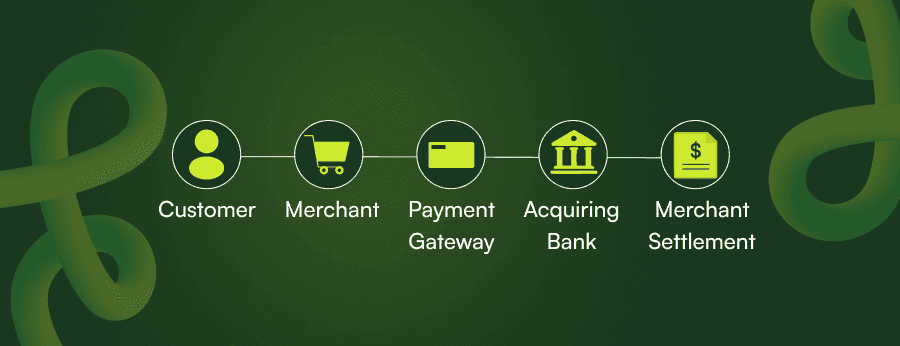
Who is involved in payment settlement?

Customer

initiates financial transaction

Payment gateway

transfers payment details between parties. Via a payment gateway, information passes. Via the payment gateway, data is transferred in protected form

Payment processor

processes transaction and sends data to card network

Card network, Visa, Mastercard

routes transaction and participates in clearing process

Issuing bank

issues the customer’s card and checks funds or credit

Acquiring bank

receives funds and transfers them to merchant

Merchant

receives payout and performs reconciliation

Why settlements are not always instant

Fraud prevention and chargeback protection require time. Batch cut-off — if a transaction did not get into batch, it moves to the next day. Business day — payments are not processed on weekends. Regulatory compliance — checks can delay settlement. Payment method — different payment services have different settlement options.

Delays protect merchant from fraudulent transactions. Reliable payment infrastructure requires time. Secure payment and fraud prevention go hand in hand with delays.

Payment gateway 
settlement process

Types of settlement: gross, net and instant settlement

Gross settlement — each transaction is processed separately. Net settlement — banks calculate mutual obligations and transfer the difference. Instant settlement — available from some providers, but not universal.

Different settlement types affect cash flow and reconciliation. Payment gateway settlement can be different depending on payment service provider. Online payment gateway also offers different options.

B2B payment gateway with transparent settlement process simplifies management.

Ready to Accept Online Payments?

Clearing vs settlement: what is the difference?

Clearing is the exchange of transaction records and calculation of obligations. Settlement is transfer of funds. Clearing process does not transfer money — it prepares data. Settlement process moves money.

Payment network, Visa and Mastercard, participates in clearing. Acquiring bank and issuing bank exchange data. Transfer of funds happens after clearing.

Example: the client pays by card. Authorization happens instantly. Clearing happens at the end of the day — banks exchange data. Settlement happens in 1–2 days — money goes to merchant account. Reconciliation is matching transaction records.

What can affect settlement speed and reliability?

Payment method.

Card payments are processed faster than bank transfer.

Acquiring bank.

Bank settings affect settlement cycle.

Issuing bank.

Responsibility of the customer’s bank — delays can be on its side.

Transaction amount.

Large amounts can be delayed.

Refunds and chargebacks.

Returns and disputes affect the final amount.

Fraud checks.

Fraud prevention can delay settlement.

Bank holidays.

Business day means working days only.

Currency/cross-border routing.

International transaction is processed longer.

Incorrect bank/KYC details.

Errors in bank account delay payout.

Payment gateway 
settlement process

Common settlement problems and how businesses can reduce them

Payout delays.

Check business bank account and batch cut-off. Contact acquiring bank.

Mismatched reports.

Use reporting dashboard for reconciliation. Match transaction records daily.

Fee confusion.

Study interchange fees and payment processor commissions. Check bank statements.

Failed bank transfer.

Check bank account and payment details. Update KYC.

Held funds.

Fraud prevention can delay funds. Clarify with payment service provider.

Chargebacks/refunds.

Keep records of chargebacks. Use fraud detection to reduce risks.

Reconciliation errors.

Use reporting dashboard and automate reconciliation.

Payment settlement best practices for merchants

Know settlement cycle. T+1, T+2 or T+3 — plan cash flow.
Track payout IDs. Every payout has a unique identifier.
Perform reconciliation daily. Match transaction records with bank statements.
Monitor failed payouts. Check bank account and payment details.
Separate refunds and chargebacks. Keep separate records.
Understand fees. Study interchange fees and payment processor commissions.
Plan cash flow. Take settlement cycle into account in forecasts.
Compare settlement options. Different providers have different settlement timelines.

Frequently Asked Questions